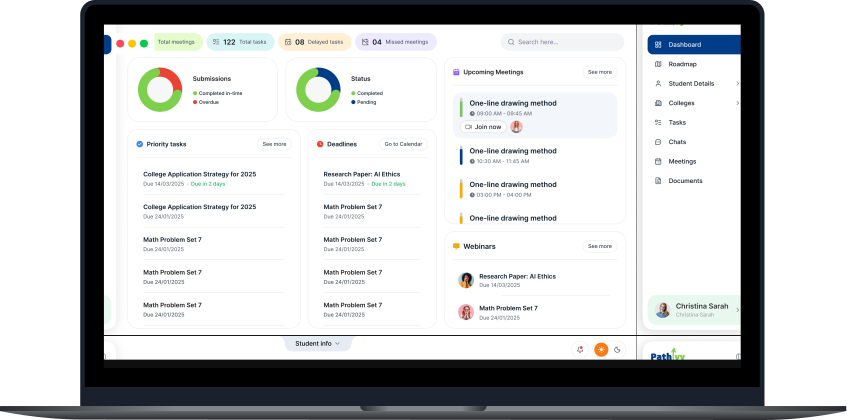
Full-Stack Web Development, AI Integration, Microsoft Graph API Integration, QA
EdTech / College Admissions Counseling
Next.js, PostgreSQL, Clerk Authentication, Microsoft Graph API
Web Application (Next.js on Vercel)
OpenAI GPT-4
The client is a college admissions counseling service that connects students with counselors to guide them through the university application process. As the business grew, the team needed a purpose-built platform to manage the full student lifecycle from initial inquiry through to application submission.
The platform serves two user groups: counselors who manage student relationships, sessions, and documentation, and students who book appointments, upload documents, and track their progress. Both groups needed distinct interfaces and access controls within the same system.
In addition to core platform functionality, the client wanted to use AI to reduce the time counselors spend on post-session administration by automatically generating structured summaries from session recordings.
The platform needed to integrate with Microsoft’s tools, which the counseling team was already using for scheduling and video sessions. The key requirements were:
Innvectra built the platform as a Next.js application deployed on Vercel, with PostgreSQL as the primary database. Clerk was used for authentication and role management, handling the separation between counselor and student accounts.
The scope of the platform was broad — two user portals, role-based access, a third-party API integration with Microsoft, and an AI processing pipeline, all expected to be live and fully functional at launch. To deliver this within the agreed timeline, the team used Cursor IDE with AI-assisted coding as the primary development environment throughout the project.
Rather than using AI tooling selectively, the team integrated it into every part of the workflow. Boilerplate for API routes, database schema definitions, Clerk role configuration, and component structures were generated and iterated rapidly using the AI pair programmer. This freed the engineering team to focus on the parts of the build that required genuine problem-solving, particularly the Microsoft Graph API integration and the session recording pipeline, both of which involved complex authentication flows and asynchronous processing logic.
The Microsoft Graph API work alone, covering OAuth token management, calendar event creation, Teams meeting provisioning, and recording retrieval, would typically take significant time to research, implement, and debug. With AI-assisted development, the team was able to draft working integration code, identify edge cases, and reach a stable implementation in a fraction of the usual time. The same approach was applied to the OpenAI session summary pipeline, where prompt engineering, transcript chunking, and structured output parsing were developed iteratively within the IDE.
The result was a production-ready platform delivered within the client’s deadline, with all features operational at launch rather than phased across multiple releases.
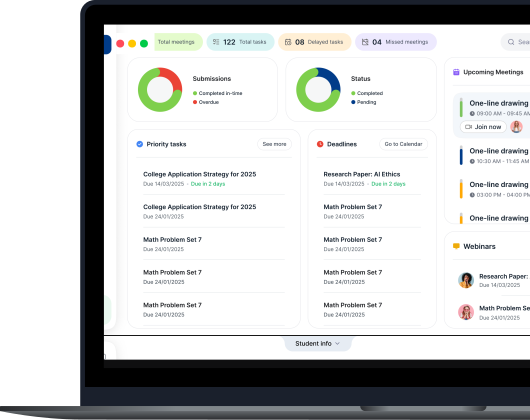
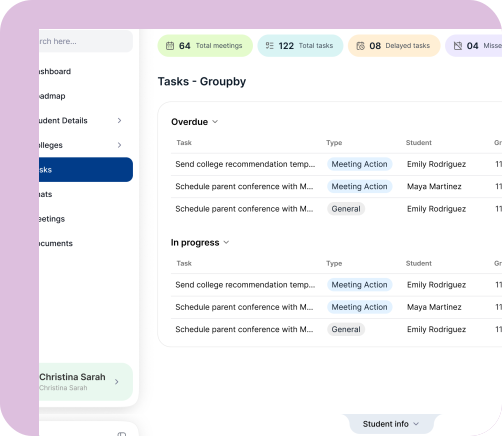
The counselor portal provides a central view of all assigned students, their session history, uploaded documents, and progress toward application milestones. Counselors manage their availability through Microsoft Bookings directly from the portal. Session recordings from Teams are available for review alongside the AI-generated summary for each session.
Students can browse available appointment slots, book sessions with their assigned counselor, and upload application documents including resumes, personal statements, and supporting materials. Uploaded resumes are reviewed by the AI, which provides structured feedback highlighting areas for improvement relevant to college applications.
The platform connects to Microsoft Teams and Bookings through the Microsoft Graph API. Appointments booked through the platform appear in the counselor’s Bookings calendar, and the associated Teams meeting is created automatically with recording enabled. Once a session ends, the recording is retrieved and passed through the processing pipeline
Session recordings are transcribed and the transcript is sent to OpenAI GPT-4, which generates a structured summary covering the main topics discussed, action items for the student, application deadlines referenced, and specific guidance given by the counselor. The summary is available to both the counselor and student immediately after the session ends.
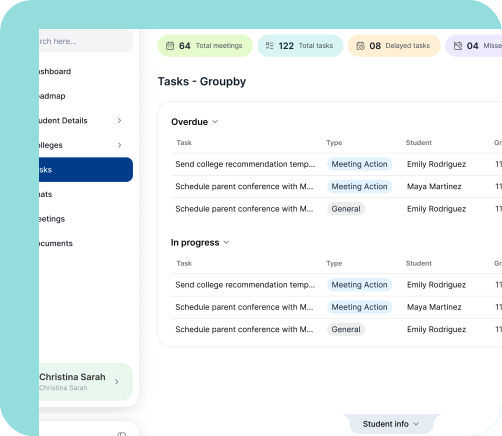
Counselor and student records can be imported in bulk via CSV, which was important for the initial setup and continues to be used as the team grows. All data is stored in PostgreSQL with a relational schema covering users, sessions, documents, and progress records.
Swift (native)
Java (native)
Firebase Authentication
Firebase Realtime Database
Google Cloud Functions (Node.js)
Bluetooth Low Energy


 Responds within 1 business day
NDA available before first call
90% of our clients come from referrals - make your own judgement.
Responds within 1 business day
NDA available before first call
90% of our clients come from referrals - make your own judgement.